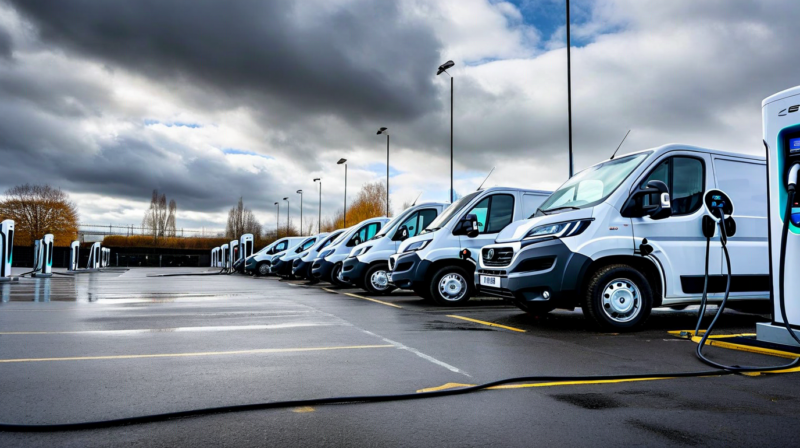
A fleet manager we spoke with last year had a straightforward question: "Why does it take us three days to get a fuel cost figure for a single depot?" The answer, as it almost always is, was complexity. The depot ran 47 diesel HGVs, 12 PHEVs, and had just taken delivery of six battery-electric vans. Three fuel types. Three billing systems. Zero integration.
The mixed-fuel reality most fleet teams didn't plan for
Five years ago, the vast majority of UK commercial fleets ran on a single fuel type. The operational model was simple: fill up, record the mileage, reconcile the fuel card. Modern fleets don't have that luxury. Government targets, manufacturer phase-out commitments, and operator-level sustainability pledges have pushed fleets into rapid transition -- and the transition is rarely clean.
What we see across the operators we work with is a patchwork rather than a plan. Diesel still dominates long-haul. PHEVs have been deployed for urban routes where the electric range is actually used. BEVs are coming in at the van and light commercial level. And in some sectors -- particularly those serving large logistics contracts -- hydrogen is no longer hypothetical.
Running four propulsion types simultaneously isn't operationally impossible. But it becomes unmanageable the moment you try to aggregate cost data across them. Each fuel type has different units (litres vs. kWh vs. kg), different billing cadences, different infrastructure costs, and different maintenance requirements. Pulling that into a single cost-per-mile figure requires a data model that most fleet management systems weren't built to support.
Where the data infrastructure breaks
The first failure point is almost always measurement. Diesel consumption is measured by the litre. Electricity is measured by the kWh -- but charging events may come from three different sources: depot chargers, public charging networks, and home charging for PHEVs driven by company car holders. The home charging reimbursement piece alone is a data nightmare; HMRC's advisory electricity rate exists precisely because no one actually knows what rate to use.
Hydrogen adds another layer. There are currently no standardised hydrogen cost reporting formats in UK fleet management. Operators who have taken delivery of hydrogen fuel cell vehicles are often recording those costs in a separate spreadsheet and manually transcribing them into their fleet management system monthly. That's not a workflow -- it's a data liability.
The second failure point is comparison. When your diesel fleet runs at 12p per mile and your BEV fleet runs at 4p per mile, that looks like a compelling transition story. But if the BEV figure excludes charger depreciation, infrastructure installation amortisation, and the additional maintenance overhead on charging equipment, you're comparing a fully-loaded cost against a partial one. In our experience, the BEV total cost of ownership is lower -- but only when you're measuring the same things in both columns.
What a mixed-fuel data model actually needs
Managing a mixed-fuel fleet well requires a data model that treats energy type as a variable, not as a system architecture decision. That sounds obvious. Very few fleet ERP systems are actually built that way.
The model needs to:
- Accept consumption data in multiple units and convert to a common denominator (typically pence per mile or cost per kilometre)
- Capture infrastructure costs separately from fuel/energy costs, with amortisation logic that allocates them correctly to the vehicles using that infrastructure
- Handle multiple billing sources for the same vehicle -- a PHEV might have a fuel card, a home charging reimbursement, and a depot charge event all in the same week
- Flag anomalies across fuel types -- a spike in diesel costs doesn't mean the same thing as a spike in charging costs, and your exception handling logic needs to know the difference
The organisational challenge nobody mentions
Data model aside, there's a harder problem: the mixed-fuel fleet is owned by operations but reported on by finance, and the two teams are often using completely different source systems. Operations tracks fuel consumption. Finance tracks invoices. Neither figure matches the other because neither system is aware of the other.
We've seen this play out in budget variance reviews where a fleet team presents a cost per mile that's 18% lower than the figure on the finance report for the same period. Both are technically correct. Both are measuring something real. The problem is they're measuring different things, and nobody has defined which figure the business should be managing against.
"The question isn't which fuel type to use. It's whether your data infrastructure can handle the answer changing constantly." — ExoFleets Team
Starting points if you're mid-transition
If you're already operating a mixed-fuel fleet and the data situation is messy, the practical starting point isn't a system overhaul. It's definition. Agree, at the organisational level, what "cost per mile" includes. Write it down. Make it the same definition whether the vehicle is diesel, electric, or hydrogen.
From there, the integration work becomes more tractable. You know what data you need, which means you can identify where the gaps are, which means you can prioritise the integrations that will have the most impact on your reporting quality.
The fleets that are managing mixed-fuel operations well right now are not necessarily the ones with the most advanced technology. They're the ones that defined what they were trying to measure before they bought a system to measure it. That sequence matters more than most people think.
If you're dealing with mixed-fuel data complexity in your fleet, talk to us. We've built ExoFleets specifically to handle the data model challenges that come with multi-fuel, multi-site operations.