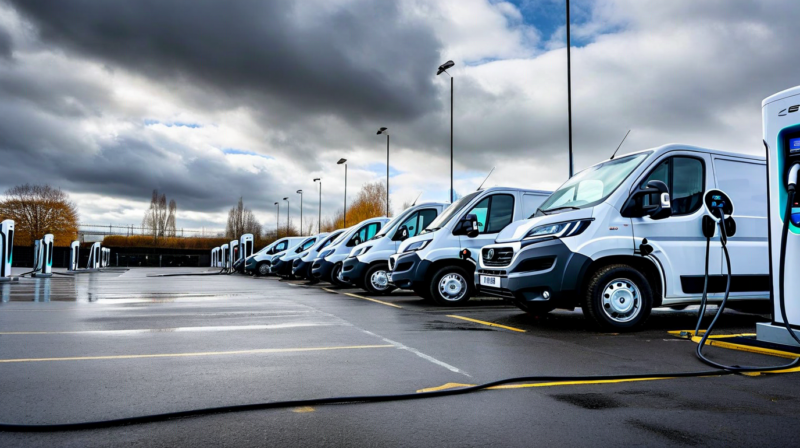
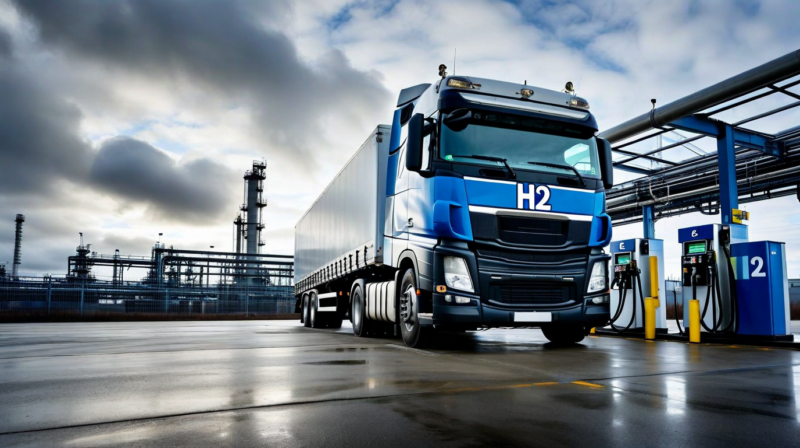
The UK government's decarbonisation commitments for road transport are among the most ambitious of any comparable economy. Net zero by 2050. No new diesel or petrol cars and light vans from 2035. Clean energy infrastructure targets that, if met, would fundamentally change the economics of fleet operations. The question that doesn't get asked often enough is: where are fleet operators actually against these targets, not in terms of aspirations, but in terms of the vehicles currently on the road and the data infrastructure to manage the transition?
The headline targets
The Zero Emission Vehicle (ZEV) Mandate, phased in from 2024, requires manufacturers to ensure a rising percentage of new car and van registrations are zero emission: 22% in 2024, rising to 80% by 2030 and 100% by 2035. For heavy goods vehicles, the timeline is longer: no new diesel HGVs (over 26 tonnes) from 2040, with a full phase-out target of 2035 for lighter commercial vehicles.
These are manufacturer obligations, not fleet operator mandates. But they directly affect what vehicles fleet operators can buy and when. A fleet that needs to replace a cohort of large diesel HGVs in 2031 will be doing so in a market that's increasingly constrained on the diesel side and still maturing on the zero-emission side.
The current state of UK fleet electrification
The car and van fleet is ahead of the HGV fleet. Battery electric van sales have grown significantly since 2022, and total electric fleet uptake for light commercial vehicles is tracking broadly in line with ZEV mandate progression. The infrastructure picture, while patchy in some regions, is no longer the primary barrier for operators running urban or sub-200-mile routes.
The HGV fleet is a different story. Battery electric HGVs are available from multiple manufacturers, but real-world range limitations at heavy payload, limited public charging infrastructure for overnight stops, and the total cost of ownership premium versus diesel mean that uptake remains small relative to the fleet size. As of late 2025, zero-emission vehicles represent less than 2% of UK HGV registrations.
| Vehicle Class |
Key Deadline |
Current ZEV Share (est.) |
Assessment |
| Cars |
100% ZEV new sales by 2035 |
~20% new registrations |
On track for mandate |
| Light Vans (<3.5t) |
100% ZEV new sales by 2035 |
~8% new registrations |
Accelerating but behind pace |
| Medium Trucks (3.5-26t) |
Phase-out 2035 |
<3% new registrations |
Significant gap |
| Heavy HGVs (>26t) |
Phase-out 2040 |
<1% new registrations |
Early stage, dependent on infrastructure |
The data gap inside the transition
There's a less-discussed dimension to fleet decarbonisation that's worth naming directly: the data infrastructure gap. Decarbonisation progress is measured in emissions. Emissions are calculated from fuel and energy consumption data. If that data is incomplete, the reported progress is incomplete -- but nobody knows by how much.
The fleets that are furthest behind on decarbonisation data are typically the ones with older, more heterogeneous fleets: mixed vehicle types, partial telematics coverage, manual fuel card reconciliation, and no systematic capture of EV charging data. These are also, not coincidentally, the fleets that face the largest operational transition challenge.
Getting to a credible baseline emissions figure is a prerequisite for meaningful decarbonisation planning. You can't set a reduction target against a figure you don't trust. You can't measure progress against a baseline you haven't established. And you can't demonstrate compliance with customer or regulatory reporting requirements using estimates.
"Every fleet operator we talk to wants to decarbonise. Very few have the emissions baseline data they'd need to actually plan the transition. That's the work we do first." — ExoFleets Team
What fleet operators need to do now
The practical implication of the decarbonisation timeline is that fleet operators need to be acting now, not because the 2035 and 2040 deadlines are imminent, but because the steps needed to meet them take time and have dependencies.
- Establish a current-year emissions baseline. Vehicle-level, fuel-type-attributed, with DEFRA methodology applied consistently. This is your starting point for all subsequent planning.
- Map your fleet against the transition timeline. Which vehicles will require replacement under the ZEV mandate, and when? How does your current acquisition and disposal cycle align with the transition deadlines?
- Assess route and duty cycle compatibility. Which routes and vehicle classes are immediately viable for electrification? Which require infrastructure development or technology maturation before they're viable?
- Build the data infrastructure before you need it. The data demands of a mixed and transitioning fleet -- multi-fuel cost management, EV battery health tracking, emissions reporting -- are different from a purely diesel fleet. Building the capability before the vehicles arrive is materially easier than building it after.
None of this is simple, and none of it happens overnight. But the operators who are ahead of the curve on UK fleet decarbonisation haven't done anything extraordinary. They've just started earlier, been more systematic about their data, and made decisions based on evidence rather than assumptions.
ExoFleets supports UK fleet operators from emissions baseline to transition planning. Request a demo to see how our platform handles the data demands of a decarbonising fleet.